Thursday, February 18, 2010

[Tech] GIT:Mercurial = Assembler:Java

I am using Mercurial since about half a year pretty regularly and I am also (forced) to use GIT recently. And I must say, that I am not pleased with the GIT experience at all. An initial statement first, though: I am not arguing about features here; it is no doubt, that GIT is an extremely powerful and also reliable sourcecode management system. But the user experience is, in my opinion, questionable at least. 

The first time I got into contact with distributed SCM systems was through Mercurial. There are some new concepts that have to be understood (coming from Subversion), but generally spoken it is pretty easy to start with. Simple things are simple, complex things are mostly reasonable to understand. The basic set of commands and switches is kept simple and are hence easy to learn and understand. One is not flooded with commands and options in the beginning; specific functions (e.g. patch queues, rebasing, ...) can be switched on later by enabling the very extension. About 35 extensions are part of the Mercurial distributions and can be enabled by adding one line to the config file. Other extensions can be installed when needed.

In my opinion, this is a very clever way to hide unecessary complexity in the beginning and to provide the new user with a clean and simple set of commands. Later on, enabling specific extensions allow a "fine-tunes" feature set. Along comes a concise but pretty good help documentation.  One example: "hg help log" explains the log command in about one screen page.

The first encounter with GIT on the other hand is in my opinion rather terrible. Try "git help log" and you get around 20 (sic!) screens with Unix-style documentation (and this is not meant as a compliment) of the log command. There is a lot of documentation on the GIT homepage though. But there are a lot of other "goodies" in the man pages as well. One more example? 

Well: "hg glog" shows me a representation of the history of my repository including branches. "git log" does only show the current branch. OK, so there should be an option to control that. Well, first of all: good luck with 20 man pages... Then I searched for "/branch" in the man-page and found the "--branches" switch (which apparently does the job). Yet what do I find as explanation of this switch?
--branches: Pretend as if all the refs in $GIT_DIR/refs/heads are listed on the command line as
I am a very peaceful character, but honestly, when I read such a statement in a documentation, I feel the urgent need rising to beat the developer who wrote that line.

The Git community book that is (according to the website) "meant to help you to learn how to use GIT as quickly and easily as possible" start in the first chapter with a detailed explanation of the internal GIT data model instead of explaining fundamental principles of DSCM und Git. WTF? To be fair, there is a set of other documentation artefacts on the website that appear to be significantly better for starters though.

The main issue in my point of view, all considered, is the lack of encapsulation/layering of functionality. What is done great in Mercurial (e.g. with extensions) is done very bad in GIT.  My feeling with GIT is, that there is at least one level of abstraction too few in the design. The user experience reminds me to the less good student projects I have seen over the years: In many of these projects there is no need to take a look at e.g. the ER diagram or database schema: a glance at the GUI is sufficient. Each database table is represented in the GUI, probably separated by "tabs". "Great" design: all internals layed out to the user, who is usually not interested in technical details, but in solving a specific (higher level) problem.

I got a similar feeling with GIT: no doubt it is technically on a very (!) different level than the mentioned student projects, but the usability feels pretty much the same. With nearly every interaction I have not the impression of solving my SCM problem, but interacting with technical details I am not actually interested in. It feels like cars in the 1920 (or Vespas in the 90s), you spend more time under the hood fixing some crap then driving to your destination.

I really hope, that the GIT team is going to improve the user interface. in the future.  Allowing low-level ("assembler commands") for specific purposes and experts and a significantly better abstracted set of commands for "day to day" operations. Consequentially, at the moment, I would definitly recommend Mercurial over GIT, simply by the much better user experience and layering/abstraction of functionality.

p.s.:  5min after I wrote this article, I figured, that Martin Fowler wrote an article yesterday about VCS;

Wednesday, February 17, 2010

[Tech] Balsamiq Mockups

If you develop Client or Web applications providing a User Interface you end up with questions like:

  • Which GUI do we provide
  • Elements (Input fields, Buttons, etc.) should the GUI contain
  • What is the structure of the GUI
  • and many other questions
Usually you have several workshops with the end users who work with the final software systems. Balsamiq mockups is a great tool to create mockup GUIs in a very fast time. I always use this tool in workshops with the customer. With this smart software product you can create and tweak UI designs in real time during the meeting and the user will see the result immediateley. The tool provides a predefined mockups, like Buttons, Tables, Fields, Tabs and many other common GUI elements. There are also elements available for iPhone applications. A design of a GUI can look like this:
A more complex GUI:


Several designs can be exported to PNG images. Therefore you can create some variants and play use cases through the GUIs. Another very important point for GUI Developers is to determine common GUI components that are used in different modules of your application.

Don't paint the GUIs on yourself, the time is too valuable to waste on it.

Monday, February 15, 2010

[Arch] Event Based Programming

In his blog / twitter feed (worth following) Ralf westphal writes this:

> A "must read" for everyone interested in Software Architecture:
> About the damn being in Software Development - Coupling: http://digs.by/1Q4U
The expanded link is here.

The link references a very good Apress Book! (some pages 100 to 300 are missing).

The only thing I am missing in this book is that there are many tools out there to supervise and reduce coupling. So Event Based programming is not the only solution to complexity / coupling.

Tuesday, February 02, 2010

[Pub] Eclipse Plugin for Mule and Mule Data Mapper

The main topic of the actual Eclipse Magazin is called Plugin Parade, where I published a short article about the new Mule IDE and Mule Data Integrator, two Plugins for Eclipse. The Mule IDE provides an integrated Mule server for Eclipse. Therefore the test of Mule environments in Eclipse is very comfortable and easy. As data transformation is a significant part in an ESB, a graphical support tool such as the Mule Data Integrator provides a powerful tool for integration developers. Mule Data Integrator is an end-to-end solution for complex data integration and transformation, simplifying the development, maintenance, and deployment of data maps. One of the major advantage of the data integrator is the integrated Test Suite.

The combination of the Mule IDE and Mule Data Integrator provides a really good environment for your integration development.

Tuesday, January 26, 2010

[Conf] Cloud Computing at OOP 2010

Today I attended the session called "Cloud Computing ohne Buzzwords - und wie sieht die Zukunft aus" at the OOP 2010, provided and overview of Cloud Computing and their effects to present Software Architectures. Till this day I had no experience with Cloud Computing, and this session gave me the opportunity to hear some basic information about Cloud Computing and the benefits and risks that such a paradigme comes with. Good canditates are Amazon or Google. Both provide a wide range of services around the topic Cloud Computing.

A very interesting point is that RDBMS do not work very well in  the Cloud and alternative systems such as "NoSQL" becomes more popular through Cloud Computing:

Next Generation Databases mostly address some of the points: being non-relational, distributed, open-source and horizontal scalable. The movement began early 2009 and is growing rapidly. Often more characteristics apply as: schema-free, replication support, easy API, eventually consistency, and more. So the misleading term "nosql" (the community now translates it with "not only sql") should be seen as an alias to something like the definition above [Source: http://nosql-database.org/]

From my point of view, new kind of software systems make use of new platforms, such as Facebook, LinkedIn, Twitter in order to persist their data. And these platforms use this new mechanism to persist data. There are already interesting frameworks, such as CouchDB, Amazon SimpleDB and many others. A list of NoSQL candiates can be found here.

The session also provides some other interesting information:
  • Characteristic of Cloud Computing
  • Public and Private Clouds
  • Grids vs Cloud
At present Cloud computing is the new Hype and Software Engineers must track this topic!!

Friday, January 15, 2010

[Misc] Software Carpentry


In "Interviews with Innovators" Jon Udell talked recently with Greg Wilson. Greg Wilson is well known for his "Software Carpentry" courses. These courses did not focus on computer science students but mainly on students from other scientific disciplines like Chemistry, Physics or generally engineering studies. His goal in the "carpentry" courses was, as I understand it, to teach scientists who need Software for their work the essential tools and practices. I have the feeling, that this is pretty similar to our "best practice" efforts like our websites, this blog and the book.

However, the motivation is very interesting. One nice example he gave comes to my mind: He occasionally noticed that scientists (using apparently Matlab and the like) use functions mainly for code that is not used any more. Pretty counterintuitive? Well: they use to write the code (as it is possible in many scripting languages also e.g. in Python) in "Spaghetti" script style; as soon as they make major updates they put unused code (that they still want to keep for some purposes, because they also are not aware of versioning tools) into a function, because code in a function is not executed automatically. Nice approach ;-)

However, aside these extreme examples there is, in my opinion, a lot to learn also for education in "regular" computer science classes. As Wilson puts it in an example:
"The research money and PBS Nova programs focus on artificial hearts when in fact all the increase in longevity comes from clean water, anti-smoking campaigns, better nutrition, vaccination and the like. These routine public health measures that no longer are exciting, so they are actually loosing ground."
The same is probably also true in Software Engineering education: 95% of  engineering, but probably also of IT students will not develop the next "Google" but some Web-Forms that connect to a database and produce some reports. But this should be done in an efficient and maintainable way.

I believe this is an interesting thought: we write develop and focus on the latest "cutting edge" technologies, probably leaving the majority of developers behind and probably even worse: confusing them more every day with always new approaches and tiny improvements instead of focusing on the problems the majority of developers and companies have.

Listen to the interview and share your opinion!

Wednesday, December 30, 2009

[Tech] Distributed SCM: Playing with Repos

As some may have noticed, I migrated nearly all my projects in the last year from Subversion to Mercurial (and GIT). Step by step, as I am rather conservative with changing to new technologies, particularly when they are at the heart of the project. And changing the SCM is sort of a surgery on the open heart.

However, after nearly a year of experience I must say, SCM was (for me) never easier and more enjoyable than with distributed SCMs, particularly with Mercurial. Excellent documentation, easy and straightforward to use. Yet these days I was asking myself: If I would have to name one outstanding feature that would convince me to change from a centralised system like Subversion to DSCM, what would it be?

The answer might be surprising, but for me it is clearly this: No headache and fear when working with the repository any more. What do I mean with that? Well: I was never a Subversion guru and everytime I needed to do an operation I did not do very often (branching, merging) I was sweating. Should I press the button, am I making a mistake? What exactly do these options mean in the SVN client? Did Eclipse now mess up the local copy? Should I commit? After all, you are always working with the repository. If you mess up, you have a problem, and all team members with you. Not a nice procedure.

But with a DSCM there is no master repository, hence in case of doubt I make a clone, play around with the clone. Should I mess it up, I delete the clone and nothing happened. If everything is fine I push the results. This is for me personally the most essential feature of systems like Mercurial. I can play around even with esotherik plugins and features without the fear to destroy anything. This also makes learning for new users way easier.

What is your opinion?

Tuesday, December 29, 2009

[Pub] Best-Practice Book and the New Year

Some of you might already have noticed, that we were not very active in blogging the last months. The reason is, that (most of us) were heavily involved in finishing our "Best Practice Software Engineering" book that will be available Feb/March 2010. The publisher is Spektrum Akademischer Verlag (Springer), the book is in German.

It was a lot of work and required most of our publishing energy. I believe the result is good and I hope that it will be useful for some of you.

A detailed description of the book can be found at the publishers website.

If you are as enthusiastic as we are, you can even pre-order it via Amazon ;-)

So, for now, I want to thank all readers of our Blog, hope you had a successful 2009 and wish you all the best for 2010. Looking forward to comments from you about our book and upcoming blog posts.

Sunday, December 27, 2009

[Tech] Simple Java Template Engine

Template engines are widely used in Web Frameworks, such as Struts, JSF and many other technologies. Apart from classical Web Framework, template engines can be very useful in integration projects. In an actual integration project that deals with a lot of XML data exchange, I discovered the Java Template Engine Library FreeMarker. This Open Source Library is a generic template engine in order to generate any output, such as HTML, XML and any other user defined output based on your given template.
"[...]FreeMarker is designed to be practical for the generation of HTML Web pages, particularly by servlet-based applications following the MVC (Model View Controller) pattern. The idea behind using the MVC pattern for dynamic Web pages is that you separate the designers (HTML authors) from the programmers. Everybody works on what they are good at. Designers can change the appearance of a page without programmers having to change or recompile code, because the application logic (Java programs) and page design (FreeMarker templates) are separated. Templates do not become polluted with complex program fragments. This separation is useful even for projects where the programmer and the HTML page author is the same person, since it helps to keep the application clear and easily maintainable[...]"
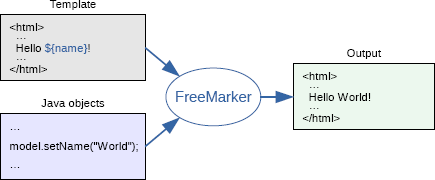
I think HTML is one application area of FreeMarker. Consider 3rd party systems providing APIs consuming XML data or their own data structures. Construct their data format in the code is a grubby approach and furthermore the code becomes not maintainable. Using such a library you can manage your data exchange template outside your code and produce the final data by using the template engine. I see such template engines as classical transformers as in an Enterprise Service Bus:

In the above exmple you see, that you can use placeholders in your template files, which will be replaced by the real data when the transformation takes place. FreeMarker provides enhanced constructs such as if statements, loops and other stuff which can be used in your template files.

Template engines are often used in Web Frameworks, but the usage of template engines is also very useful when you must produce specific output for other systems.

Monday, November 09, 2009

[Tech] Integrate Tests as a Language Featuere?

The blog of Cedric Beust (author of TestNG and captured by Google) is always an interesting read.

His last posting discusses the question if generic test features should be included into the language:

http://beust.com/weblog/archives/000522.html

He mentioned an interesting D feature. Personally I think a tighter language integration is useful for small projects. Nevertheless it should be easy to switch to the best testing tools (as TestNG) in bigger projects.

What do you think?