In his blog / twitter feed (worth following) Ralf westphal writes this:
> A "must read" for everyone interested in Software Architecture:
> About the damn being in Software Development - Coupling: http://digs.by/1Q4U
The expanded link is here.
The link references a very good Apress Book! (some pages 100 to 300 are missing).
The only thing I am missing in this book is that there are many tools out there to supervise and reduce coupling. So Event Based programming is not the only solution to complexity / coupling.
Showing posts with label Architecture. Show all posts
Showing posts with label Architecture. Show all posts
Monday, February 15, 2010
[Arch] Event Based Programming

Tuesday, October 27, 2009
[Arch] Resource for Software Architecture
I've found a realy good resource for german audience about software architecture hosted on MSDN. On the MSDN Architecture Center you'll find:
- Actual news and trends about software architecture
- Basic information about software architecture (concepts, styles, etc.)
- Podcasts
- Tool Previews
- A free english architecture journal
- Forum and Knowledge Base
- Tips and Tricks
Advance your architecture skills by looking at this resource. It is worthwhile itself to make a view to this resource.
Thursday, August 20, 2009
[Arch] UML Tools for Mac OS X
Following up a question I received via Twitter, and the fact, that a significant part of the developer-community is using Macs, I thought this might be a good opportunity to discuss some "UML Options" for the Mac. Now, this article is not meant as a definitive answer, I would hope for some follow-ups by readers in the comments.
Ok lets start: First there is heavy weight stuff, most notable Visual Paradigm. A warning: this is a fat tool. However, among the fat tools it is the one I liked the most. I am not using it any more, but it is generally rather easy to use and very feature rich. However, it is a pretty expensive commercial tool. Yes, they have a "community edition", because it is cool to have a community edition these days. But this one was (when I used it last year) rather a joke. See it as a test-preview.
There are also other commercial tools as well, e.g. Omondo. I have not much idea about this one though. Anyone?
On the other end of the spectrum are tools like UMLet (or Violet), which are also Java-based and work more or less good also on the Mac. These tools are very basic and one should not expect much. They are definitly not suited for "real" projects or commercial application, but can be a nice option e.g. for educational purposes. Sometimes one just needs to create some simple UML diagrams for a presentation, paper or book. For such purposes these tools might be useful. Plus both are Open Source tools.
The probably best free (but not Open Source) UML tool, and the one I would recommend is BOUML and this is sure worth a try. The main issue I have with nearly all free/OS UML tools is, that they are often driven by a single person or just very few developers. Hence the future of the particular tool is always a little unclear. To make things worse, there is no accepted open file-format for UML diagrams, that would allow easy exchangeability of the tool. Hence selecting a UML tool is always sort of a lock-in situation.
Also a consideration could be ArgoUML, which is also an Open Source tool and maybe the oldest one around. Has some issues as all OS tools, but apparently has a functioning community.
Finally there are some more or less general purpose drawing programs, that can be used for technical diagrams like EER or UML models as well (with some limitations) like OmniGraffle or Concept Draw and finally also OpenOffice Draw can be used for general purpose vector-oriented diagrams.
Would be happy about comments, experiences and further suggestions!
Thursday, July 02, 2009
[Pub] Mule Tutorial
In the current issue of the Java Magazin I published a tutorial to develop loose coupled systems with Mule. The tutorial illustrates the usage of an Enterprise Service Bus in an airport domain, where different airport systems communicate with each other over the ESB. In the example I use a set of important Enterprise Integration Patterns and show how these patterns are implemented in Mule. Some patterns I used are:
- Event Driven Consumer
- Content Based Router
- Filter
- Transformation
- Message Splitter
- JMS (Active MQ as message broker)
- Quartz Transport
- File Transport
- XMPP transport for instant messaging
Have Fun!
Monday, June 29, 2009
[Misc] Hot deployment with Mule 3 M1
Some interesting news from the Open Source ESB Mule. The first milestone from the third version of Mule is out and comes with a major important feature: Hot Deployment
What is the meaning of hot deployment?
Hot deployment is a process of deploying/redeploying service components without having restart your application container. This is very useful in a production environment when you have multiple applications connected over the enterprise service bus without having to impact users of applications.
Check out the example on the mule homepage.
Tuesday, April 14, 2009
[Arch] Maven Best Practices
In this blog of sonatype there is a useful list of best practices with Maven, including:
- Why putting repositories in your pom is a bad idea
- Best Practices for releasing with 3rd party snapshot dependencies
- Maven Continuous Integration Best Practices
- How to detect if you have a snapshot version
- Optimal Maven Plugin configuration
- Adding additional source folders to your maven build
- Misused maven terms defined
- How to override a plugins dependency
- How to share resources across projects
- How plugin versions are determined
Wednesday, April 08, 2009
[Tech] Google AppEngine (and Java)
AppEngine is a rather recent new service from Google. It is probably Google's answer to Amazon's cloud-computing platform, yet targets a very different market. Where Amazon offers a a broad range of services and high flexibility (with the disadvantage of higher administration effort) Google targets web-developers that want to publish web-applications. AppEngine started with a Python environment, now since some days the long anticipated Java-version (Java 5 and 6) is online. Now what are the benefits of using AppEngine?
Java
First of all, it is possible to deploy applications without having to install, administrate and maintain an own server (instance). Google provides a runtime environment (sandbox) into which Python or Java applications can be deployed. Access to these applications is (for clients) only possible via http(s). So this is a feasible approach for web-applications or RESTful services.
An additional advantage is, that Google deals with scaling issues, i.e. it scales the applications dynamically to the demand. This is a significant advantage for startups, that have no clear idea about the number of customers they are going to have or how fast this number is growing. For the scaling to work, though, some restrictions have to be considered. Most notably this concerns the persistence strategy. E.g. applications (and libraries!) are allowed to read files from the filesystem, but are not allowed to write. For all persistence issues, the Google datastore has to be used. However, what is nice with the new Java-sandbox is the fact, that Google apparently tries to follow established standards. For persistence Java developers can use JDO or JPA or a low-level interface for the distributed datastore.
I wonder, however, how logging can be handled in that environment. Logging is usually done to a file or to a JDBC datasource. A JDO logging target I have not seen before; ideas anyone?
Generally spoken, arbitrary Java libraries can be deployed and used in the AppEngine as long as they do not violate the AppEngine sandbox. Also due to the scaling-approach not all libs/frameworks will run unchanged. As yet, it seems not quite clear for example, which Java Web-Frameworks will run seamlessly in the App-Engine. Googles webtoolkit (GWT) should work, other framework communities are currently testing their frameworks for compatibility, e.g. in the Apache Tapestry and the JSF framework Apache myFaces discussions are running on the mailinglists.
Build Automation and Development Process
The development process is, in my point of view, as also with other Google environments like GWT a mixed blessing. Everything is Eclipse centered, which is not really a good thing: Google provides an Eclipse plugin for the AppEngine including a runtime environment for testing applications offline. This is great for daily development activity, but not for a stable build- and testing environment. Unfortunately Maven support (like archetypes) are completly missing at the moment. Google is apparently pretty hostile towards Maven and focuses mostly on IDE integration, which is definitly not a sound way for a modern build automation. IDE "wizard-based" SE approaches usually turn out to be unstable and problematic, particularly in team-projects. This might be nice for a fast hack, but is no basis for a larger project. It seems, that some support is given for Apache Ant though.
Hopefully other developers will provide a Maven integration for the Java AppEngine. With the current approach not even an IDE-less deployment is possible.
Conclusion
So, despite of the build-issues, I believe that the AppEngine is a great option to deploy web-applications in Java or Python. For small applications (small in the sense of "low web-traffic"), the AppEngine is free, after exceeding certain thresholds (CPU, storage, bandwith...) one pays according to the resources needed. Google provides a web-interface to set daily financial limits for individual resources. E.g. one wants to spend a maximum of 5 $ a day for CPU time and so on.
Looking forward to the first experience reports, particularly with web-frameworks like Wicket, Tapestry or Cocoon.
Friday, February 27, 2009
[Arch] Cherish your Architecture
Since a few month I am following the world of architecture tools much more and there are interesting things on the way:
- hello2morrow has changed the evaluation mode for one of it's product: SonarJ (Community Edition) is now free for trial if you have less then 500 classes. I strongly recommend to use a tool like this at least for every new project start. Quality metrics and architecture definitions are now just a few clicks away and do really suppress 'the big ball of mud' every software engineer knows.
- Another nice product in the field of software quality measurement is sonar from codehaus. It really produces wonderful quality views for projects and I highly recommend to try it out. What disappointed me a little was that Java projects should be Maven alike and the two minute tutorial will not cause you to set sonar up in two minutes (installing, loading and producing metrics in SonarJ is much faster). But nevertheless the output is full of innovative ideas.
It was also interesting to learn that sonar has ideas to integrate something like the architecture rule checking framework macker. You can try this out for yourself and integrate it now into your Ant buildfile if you have a vision about your architecture. Do you have?
Here is an example of an architecture definition given on their website (think of everything being enclosed with XML brackets):
macker
..ruleset name="Simple example"
....access-rule
......deny
........from class="**Print*"
........to class="java.**"
......deny
....access-rule
..ruleset
macker
Do you have an idea of the intention?
Obviously a helpful feature but keep in mind that other tools (like the ones from hello2morrow) allow this definition much faster because you simply draw your architecture.
So check everything out and be aware of your architecture!
Tuesday, January 20, 2009
[Pub] Data transformation in an SOA
I published a german on article on JAXCenter about data transformation in Service Oriented Architecture. When different applications talk to each other, you must find a suitable data format which all applications can interpret. For the most cases XML is the first choice, because there is a wide range of tool support and additional standards, like Schema Editors, XPath and the like.
In this article I give an overview about the Open Source Framework Smooks, which can be used for data transformation in SOAs. Smooks provide some interesting features:

- Data Transformation (XML, CSV, EDI, Java, JSON,..) and custom transformers
- Java Binding from any data source (CSV, EDI, XML,..)
- Huge message processing by providing concepts like split, transform or route message fragments. You can also route fragments to different destinations, like JMS, File or databases
- Message Enrichment
Above mentioned attributes/features are also ideal candiates where an Enterprise Service Bus can help. Rather existing Open Source ESBs, like Mule or JBoss ESB can profit from a technology like Smooks. In last part of the article I describe the Smooks extension for Mule which provides:
- Smooks Transformer for Mule. The transformation logik is done in Smooks
- Smooks Router for Mule. The routing logik can be configured in Smooks
Sunday, January 04, 2009
[Misc] Clean Code Developer
Some days ago the recommended .NET Expert Ralf Westphal (with Stefan Lieser) has published in his blog (which is always worth reading) about a new Software Engineering Website called Clean Code Developer (written in german).
The websites name is a little related to the book clean code from Robert Martin I recently reviewed here.
To me this website is stunning in many ways. It is the approach to bring professional development into the minds of all developers. And so it lists and explains the most important development principles on this webpage. Furthermore all tools are listed that help to achieve the goal of good development.
But the website doesn't stop here: a related forum for "clean code" discussion has been set up and they have introduced grades for every developer. So the principles have been rated and put into six grades that are associated to colors (from red to white). So every developer can learn and practice these grades and the included clean coding principles.
For those who have fun doing this you can buy a colored bangle starting from red and buying the others later for 5 €. The idea is to remind yourself always writing clean code. Whether you like the last idea is up to you. But this website really bridges an educational gap: at the university you normally learn programming and something like design patterns in an advanced software engineering course (beside of tons of UML). You nearly never learn good coding principles although many of us will code in
their later career.So as my new years recommendation I would be happy if you can check out the website given above and join the idea of a clean code awareness.
Let this be one of our answers to the financial crisis.
Friday, December 19, 2008
[Arch] Application Architecture Guide
The architecture and design of software applications should be technical neutral. The Application Architecture Guide from Microsoft guides developers through the design of applicataions based on the .NET platform. In my opinion, this architecture guide not only focus on the .NET platform and is a really good cookbook for Software Architects. As we present in our Best Practice Project, design patterns, are technical neutral and can be used in any language. The design principles of a Data Access Object or a Proxy are the same in Java as in .NET.
The guide can be used as a reference and provides the following five parts: Fundamentals, Design, Layers, Quality Attributes and Archetypes - Desgin and Patterns.
Fundamentals
The first part focus on fundamental architecture concepts, including application Archetypes, Layers and Tiers and Architectural Styles. On chapter focus on the .NET platform.
Design
The second part is very interesting for software analysts by providing some guidelines to design your application. Here you will find best practice approaches to make decisions about the distribution, select the right application type, choose the right architectural style (component based, message-bus,...). The chapter Architecture and Design is on of the most interesting one, because it provides guidelines to design considerations, architecture frame, persistence, security and some other topics. The last chapter Communication guidelines provides best practice approches to use the right communication between your software components and describes the design impact of choosing a communication technology.
Layers
The layers part focus on the layered architecture and describes each layer in detail, including Presentation, Business, Data Access and Service Layer. The layered architecture is on of the common used architecture styles in software projects.
Quality Attributes
In this part non functional requirements in software projects are described and how these requrements can be achieved by doing the right design. What must be account for to be secure and performant.
Archetypes - Design and Patterns
Don't compare this chapter with Maven Archetypes. The last part of the architecture guide describes different types of applictions, like Mobile Application, RIA or Web Application. This is very interesting because you will find which typical design principles and design patterns are used in such an archetype. For example one of the key patterns in Web Applications are Composite View, Front Controller, the classical MVC, Page Cahge or the page controller.
This architecture acts as Bibel for developers and you fill find less .NET code. In my opinion this guide is realy good and should be checked by every software architect and analyst.
Monday, December 01, 2008
[Arch] Archi-Zack!-ture
A few months ago I read a very good article series by Pavlo Baron about Software Architecture in the Java Magazin. Software architecture is an important component in software projects and you will find a lot of resources (books, web sites, blogs) which focus on this topic. He titled the series with Archi-Zack!-ture.
What does a Software Architect do? The role of a software architect in a software product becomes more important the more complex the system is. Software architecture is still a rather young discipline and the value of a software architect in software development is often underrated. As Pavlo describes in the first part, it's hard to seperate the role of a software architect with the role of a software developer. The architect enables developers to develop the software system by providing the necessary environment. The developer on the other side focuses on the fulfillment of the requirements. The motives are the same, but the emphasis differs.
The major part of the series are (Anti-) patterns about the software architecture. I picked up the most important one from my point of view. First I will enumerate the patterns which should be followed:
- Architect also implements
Each architect should also implement. This is very important, because as a architect you make decisions about performance, scalability and similar stuff. Without any technical backround these issues are very hard to design/answer. - Senior Developer = Software Architect
It is important the a software architect has experience in software development. - Manages makes the final decision
One man of the management must make the final decision. The software architect prepares the material which are used for the decision
- Ivory-Twoer Architect:
The purchase to the reality lost - One Man Show:
The software architect makes everything alone - Single point of decision:
The software architect must decide everything, e.g. implementation details. - Design by Committee:
On the other side, it makes no sense to make all decisions in the team which ends in a never ending discussion. A good mixture is the answer. - Architecture by implication:
Architecture is not documented. - Architecture without review:
- Meta architecture:
Software architect remains too abstract - Customers are idiots:
The Software architect is not a God!! - No Refactoring:
The management does not give time for refactoring
Some people believe that software architects are the "kings", and without them software projects don't work. The above mentioned anti patterns are found rather often in projects and architects should keep that in mind. It is not important which title is written on your business card, the content, the attitude to the project and how the project team works toghether, are the keys to the success of the project.
Wednesday, November 12, 2008
[Arch] RESTful applications with NetKernel
The architectural style REST has gained some popularity and is often brought up against SOAP for interoperable web services. REST stands for Representational State Transfer and has some characteristics that distinct itself from other architectural styles:
- Resources such as a person, an order, or a collection of the ten most recent stock quotes are identified by a (not necessary unique) URL.
- Requests for a resource return a representation of the resource (eg. an html page describing the person) rather than an Object that IS the resource. A resource representation represents the current state of the resource and as such is immutable.
- Representations contain typically links to other resources, so that the application can be discovered interactively.
- There is typically a fixed and rather limited set of actions that can be called upon resources to retrieve or manipulate them. HTTP is the best known example of a RESTful system and defines eg. GET, PUT, POST and DELETE actions.
Applications based on REST are typically very extensible, provide good caching support, and can be easily mashed up to bigger applications.
NetKernel
Using the RESTful application pattern in non web based applications is currently not very well supported by programming languages and frameworks. NetKernel is an open source framework designed to provide a simple to use environment to program RESTful applications.
Its architecture is rather simple: Programmers write Modules and register them with the kernel. Each module registers its address space that that states which logical addresses (URIs) the module will handle and which java class, script (Python, JavaScript, Groovy, …), or static resource will act upon the request and return a resource representation. A module can also register rewrite rules that translate from one address to another.
Accessing resources within NetKernel from outside is via Transports. Each module can have Transports that monitor for external system events (eg. JMS events, HTTP requests, CRON events, etc), translate these events into NetKernel requests, and place these requests into the NetKernels infrastructure that will route the request to the appropriate resource.
NetKernel supports a wide range of scripting languages uses resource representation caching to speed things up transparently for the developer. The internal request-response dispatching is done asynchronously so callers can easily state that they do not care for an answer after 10 seconds, are not interested in the response at all, or place several request first and then wait for the responses coming back. REST is most often associated with HTTP – with NetKernel one can apply the REST architecture style also to applications that do not use http; it is completely decoupled from the http stack.
Compared to other REST frameworks such as Restlet, NetKernel is extremely well documented and several large sample applications can be downloaded from their homepage to get started quickly.
Related Links
- http://www.1060.org – the homepage of net kernel.
- A recent article on TheServerSide.com about resource oriented computing with NetKernel that provide a more thorough introduction.
Sunday, October 26, 2008
[Arch] SEDA Model and scalable enterprise applications
Scalability, Performance, Fault Tolerance are classical non functional requirements when building enterprise applications. Setting up the application in a clustered environment is a very popular approach and is often used in practice.
When building process based applications you usually deal with long and short running processes. For example a order process may take one week, whereas a save transaction is a process that takes (should take) only few seconds. Short running processs often implements the backend business logic. In Service Oriented Architectures these short running processes results in a orchestration of provided services from different systems.
Mihai Lucian describes in his article a simple scenario, where different platforms in a backend process are connected by using web service endpoints. One of the platform that is queried has a slow response time. He describes one solution approach to battle to the slow response time by using asynchronous IO in servlet container and the Staged Event Driven Architecture (SEDA) model.
He mentioned that current servlet APIs do not provide methods in order to deliver data to the client in a asynchronous way. AJAX based frameworks currently use one of the modes: Polling, Piggy back and Comet. Apache Tomcat for example provides a implementation to handle asynchronous IO by decouple the requirest and response from the worker thread. So you can prepare your response later.
Now the combination with the SEDA model is very interesting, because you can route your request to the right queue. As Mule is based one the SEDA model, Mihai Lucian illustrates how to implement such a scenario in Mule (see image).
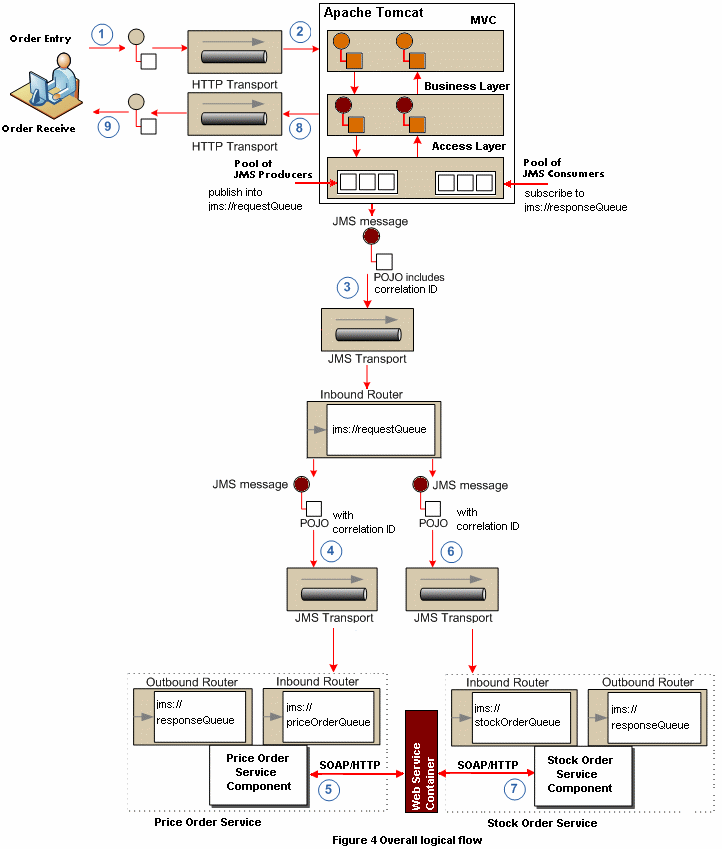
From my point of view the example is very interesting based on the following key points:
- Asynchronous communication in a servlet container
- The most interesting thing is how to correlate the request with the response through different layers
- How Mule fits in such a architecture
- Practical example of JMS
- Using Routers in Mule and route the message to the right Queue
- Using Apache CXF in Mule
A full description of the example is provided on the article homepage. At the end of the article he provides some benchmarks in order to provide a clear view of the advanateges using such an architecture.
Saturday, October 11, 2008
[Arch] Introduction to REST
REST ist an architectural style on how to let distributed applications communicate. It is considered as an alternative approach to XML:RPC or SOAP webservices. I generally like that Google Talks introduction to REST:
I would also recommend additional resources to get a more complete picture on REST, check out this link.
Monday, October 06, 2008
[Arch] OpenSource ESBs
The last couple of years major Open Source ESBs, including MuleSource and ServiceMix, have been expanded and are used in critical business solutions. Tijs Rademakers and Jos Dirksen offer a book which gives an overview about Open Source ESBs and which combination of Open Source technologies with ESBs are used. The main open source solutions covered in this book are Mule and ServiceMix. Therefore most of the examples in the book are based on these two technologies. Other Open Source ESBs that will be covered are Apache Synapse, Open ESB and the new integration framework from Spring, called Spring Integration.
In the TechBrief the authors mentioned that all Open Source ESBs focus on Enterprise Integration Pattersn. If you understand these patterns its very easy to understand the implementation and handling of ESBs.
The book is divided into three parts. The first part concentrates on reader which are not familiar with an ESB:
- Overview about ESB functionality and what Open Source ESBs are available in the Open Source market
- Taking a deep look into the Mule and ServiceMix architecture
- Installation of Mule and ServiceMix and how to run them
The second part focus on ESB core functioanlity which covers some of the Enterprise Integration Patterns. Here the reader becomes some connector examples, like JMS, JDBC, POP3 and Web Services.
The third part covers case studies and also illustrates integration scenarios with BPM engines, like jBPM and Apache ODE.
In the tech brief there was also a short comparison between Mule and Service Mix. When to use which one, is hard to say, it depends on your requirements. But in this interview on of the authors said that in a web service based architecture the JBI approach is often the better choice, but Mule is very often used, because you can also transfer Java objects, which is often very comfortable and faster. They also talk about integration of legacy systems, which is sometimes easier with Mule, because when you use Service Mix all messages must be transformed in XML.
You can download chapter 1 and chapter 4 for the book homepage.
Tuesday, September 30, 2008
[Arch] A Comparative Analysis of State-of-the-Art Component Frameworks
Andreas Pieber and Jakob Spoerk wrote a thorough and very good thesis about software components and Java-based component frameworks. The authors introduce component-based software development, derive criteria to compare frameworks and eventually discuss OSGi, Spring, J2EE, SCA, and JBI on an individual basis and in connection with each other as some problems require the combination of several component frameworks.
Dowload the thesis here.
Thursday, September 18, 2008
[Arch] Pattern Based Development of Business Applications
In a recent series Jos Dirksen and Tijs Rademakers describe "pattern based development" on the basis of Open Source Middleware (ESBs). Specifically their first article describes how to implement and integrate applications using Mule and the second article gives a good introduction into the Java Business Integration standard (JBI) and the implementation ServiceMix plus a Message broker.
Wednesday, September 17, 2008
[Arch] Requirements?!
The Waterfall Requirement
I find this really interesting: In talking with many people who actually do make Software in the last years (not only talk about it *g*) I think I detected that many have a growing problem with the term "requirement". Martin Fowler sums it up greatly in his recent blog post. He makes a strong point in saying that the understanding that many people have about "requirements" is actually still very much driven by a waterfall-like understanding of the software engineering process.
As a matter of fact, requirements seem to be problematic on so many levels: on the level of customer/programmer relationship (do they understand each other), on the level of abstraction, how to manage them, how to test if the implementation follows the requirement that we hopefully have understood correctly, just to name a few. A story often heard is "we spent months with the customer building lists and lists, pages and pages of requirements or bought expensive requirement management software, and in the end the development of the product was very decoupled from these lists; but good to know we have them in the files.".
Now my question is this: the trail from requirements to software seems still very natural to us, and it is stunning for many developers and managers that it actually oftentimes does not work. I would like to add here: sometimes it works very well, but I come to that point later. Now, what could be the replacement of requirements? (In case we agree that they do not work as intended in their traditional sense.)
Observation comes in...
Well, there are modifications of requirements engineering in agile processes like the storytelling in XP. But Martin Fowler makes an interesting other observation: Many successful web-applications actually work out the requirements as they go by providing some base-services, a platform (e.g. for exchanging photos). The very important point in this phase is to build in functionality that allows the management to observe the behaviour of the customers: which functions are they using, what are they annoyed about (forum discussions, email feedback...). Then they add experimental new features and test the acceptance (Or you can as well go the next step: let the customers develop the applications as Yahoo! Pipes shows it).
It's Alive!
The interesting point is, that this procedure was very elaborately described in the book "It's Alive: The Coming Convergence of Information, Biology and Business" written by Christopher Meyer and Stan Davis. A very recommended read. The do not describe so much the process of software engineering but rather strategies of modern enterprises and derive the core principles:
- Seed: bring in a new feature, idea; probably only to a subset of customers, probably in variations for different customers
- Select: select the successful variations
- Amplify: eventually amplify the successful ideas and bring more of that sort
Meyer and Davis brought exampled from "old economy" but actually in software engineering (particularly in web-applications) we have a very good opportunity to rather easily "seed" new features, observe the behaviour and select and then amplify the good ideas. The key point here is, as also Fowler mentions, to focus more on the "observation framework" (in a technical-, but also in a management-sense!) than on trying to get all requirements right from the beginning.
... and back to the Waterfall
Having said that, I want to come back to a point I mentioned earlier: in the "agility euphoria" some evangelists forget to mention, that there is a broad variety of different software products and engineering efforts. (and I am not speaking of safety critical systems here): In many cases actually a "waterfall inspired" process works pretty well. This can be the case in such projects where a technical guy (a developer at best) has already a lot of experience in a particular domain and is either re-writing a legacy application (a case I am observing right now) or is developing a new application that is actually following a series of similar applications and similar customers he had. And this case is quite a regular one in the industry, and we should not forget this scenario. In such cases the requirements of the new application can often be nailed down quite precisely.
Why is that? Well, actually the "Seed, Select and Amplify" process happened in this technical expert. He or she worked with old applications in that domain, often with a broad range of customers that have experiences with several systems of a sort. So he has developed quite a good understanding of (1) the domain (2) the customer (3) the competitors. In such cases the problem often lies more to get the implementation phase right and not to spoil the project on the last steps e.g., with not so experienced developers (either in the technical sense, or in the domain, or in the worst case in both). Hence agile principles as suggested by Scrum for example can be very helpful for the implementation phase to keep control of the process even though the requirements are quite stable from the beginning.
Wednesday, September 03, 2008
[Arch] Google AppEngine & Python
Cloud computing is the fashion right now and Google is positioning it's AppEngine against services like Amazon EC2. However similar on the first glance, the two approaches are rather different in detail: Amazon's service is more a virtual server hosting (where you have all freedoms, however are responsible about administration too) plus a set of webservices (like the storage services S3 and SimpleDB or the Queue Service SQS).
AppEngine offers a concrete application development environment in Python plus a simple database that has to be used. So you are limited to Python code and Python frameworks like Django and you cannot install an arbitrary database, on the other hand you do not have to deal with many administration issues and Google deals with the scaling.
Guide van Rossum, the father of Python (who is now employed at Google) gives a very interesting one-hour presentation on YouTube on how to write and configure a Python/Django web-application within the Google AppEngine environment.
Subscribe to:
Posts (Atom)