Showing posts with label Technology. Show all posts

Tuesday, March 16, 2010

[Misc] Programming from Scratch- Rareness

When you learn a programming language you usually develop small applications to analyze the pros and cons of the language. Another important part is to check the offer of available libraries, frameworks and last but not least the tool support.

Programming from scratch is the unusual way when you develop a software system. In Mike Taylers blog is a very interesting discussion about "Whatever happend to programming?". In former times we wrote compilers, operating systems and cool stuff like that. Today, the programming world is busy to look for libraries for any kind of problem and paste them together.
We did all those courses on LR grammars and concurrent software and referentially transparent functional languages. We messed about with Prolog, Lisp and APL. We studied invariants and formal preconditions and operating system theory. Now how much of that do we use? A huge part of my job these days seems to be impedence-matching between big opaque chunks of library software that sort of do most of what my program is meant to achieve, but don’t quite work right together so I have to, I don’t know, translate USMARC records into Dublin Core or something. Is that programming? Really?
Read more about this topic in his blog. I thing, especially in the Java and Open Source area, Frameworks help you to concentrate on the business case. Through to the adoption of such frameworks decrease the initial development time of new applications. But it also depends on your knowledge about the used technologies and libraries. Often it will be better to write parsers and utilty classes from scratch instead of using a open source library.

According to this blog the JaxCenter provides an online quick vote in German.

Thursday, February 18, 2010

[Tech] GIT:Mercurial = Assembler:Java

I am using Mercurial since about half a year pretty regularly and I am also (forced) to use GIT recently. And I must say, that I am not pleased with the GIT experience at all. An initial statement first, though: I am not arguing about features here; it is no doubt, that GIT is an extremely powerful and also reliable sourcecode management system. But the user experience is, in my opinion, questionable at least. 

The first time I got into contact with distributed SCM systems was through Mercurial. There are some new concepts that have to be understood (coming from Subversion), but generally spoken it is pretty easy to start with. Simple things are simple, complex things are mostly reasonable to understand. The basic set of commands and switches is kept simple and are hence easy to learn and understand. One is not flooded with commands and options in the beginning; specific functions (e.g. patch queues, rebasing, ...) can be switched on later by enabling the very extension. About 35 extensions are part of the Mercurial distributions and can be enabled by adding one line to the config file. Other extensions can be installed when needed.

In my opinion, this is a very clever way to hide unecessary complexity in the beginning and to provide the new user with a clean and simple set of commands. Later on, enabling specific extensions allow a "fine-tunes" feature set. Along comes a concise but pretty good help documentation.  One example: "hg help log" explains the log command in about one screen page.

The first encounter with GIT on the other hand is in my opinion rather terrible. Try "git help log" and you get around 20 (sic!) screens with Unix-style documentation (and this is not meant as a compliment) of the log command. There is a lot of documentation on the GIT homepage though. But there are a lot of other "goodies" in the man pages as well. One more example? 

Well: "hg glog" shows me a representation of the history of my repository including branches. "git log" does only show the current branch. OK, so there should be an option to control that. Well, first of all: good luck with 20 man pages... Then I searched for "/branch" in the man-page and found the "--branches" switch (which apparently does the job). Yet what do I find as explanation of this switch?
--branches: Pretend as if all the refs in $GIT_DIR/refs/heads are listed on the command line as . 
I am a very peaceful character, but honestly, when I read such a statement in a documentation, I feel the urgent need rising to beat the developer who wrote that line.

The Git community book that is (according to the website) "meant to help you to learn how to use GIT as quickly and easily as possible" start in the first chapter with a detailed explanation of the internal GIT data model instead of explaining fundamental principles of DSCM und Git. WTF? To be fair, there is a set of other documentation artefacts on the website that appear to be significantly better for starters though.

The main issue in my point of view, all considered, is the lack of encapsulation/layering of functionality. What is done great in Mercurial (e.g. with extensions) is done very bad in GIT.  My feeling with GIT is, that there is at least one level of abstraction too few in the design. The user experience reminds me to the less good student projects I have seen over the years: In many of these projects there is no need to take a look at e.g. the ER diagram or database schema: a glance at the GUI is sufficient. Each database table is represented in the GUI, probably separated by "tabs". "Great" design: all internals layed out to the user, who is usually not interested in technical details, but in solving a specific (higher level) problem.

I got a similar feeling with GIT: no doubt it is technically on a very (!) different level than the mentioned student projects, but the usability feels pretty much the same. With nearly every interaction I have not the impression of solving my SCM problem, but interacting with technical details I am not actually interested in. It feels like cars in the 1920 (or Vespas in the 90s), you spend more time under the hood fixing some crap then driving to your destination.

I really hope, that the GIT team is going to improve the user interface. in the future.  Allowing low-level ("assembler commands") for specific purposes and experts and a significantly better abstracted set of commands for "day to day" operations. Consequentially, at the moment, I would definitly recommend Mercurial over GIT, simply by the much better user experience and layering/abstraction of functionality.

p.s.:  5min after I wrote this article, I figured, that Martin Fowler wrote an article yesterday about VCS;

Wednesday, February 17, 2010

[Tech] Balsamiq Mockups

If you develop Client or Web applications providing a User Interface you end up with questions like:

  • Which GUI do we provide
  • Elements (Input fields, Buttons, etc.) should the GUI contain
  • What is the structure of the GUI
  • and many other questions
Usually you have several workshops with the end users who work with the final software systems. Balsamiq mockups is a great tool to create mockup GUIs in a very fast time. I always use this tool in workshops with the customer. With this smart software product you can create and tweak UI designs in real time during the meeting and the user will see the result immediateley. The tool provides a predefined mockups, like Buttons, Tables, Fields, Tabs and many other common GUI elements. There are also elements available for iPhone applications. A design of a GUI can look like this:
A more complex GUI:


Several designs can be exported to PNG images. Therefore you can create some variants and play use cases through the GUIs. Another very important point for GUI Developers is to determine common GUI components that are used in different modules of your application.

Don't paint the GUIs on yourself, the time is too valuable to waste on it.

Wednesday, December 30, 2009

[Tech] Distributed SCM: Playing with Repos

As some may have noticed, I migrated nearly all my projects in the last year from Subversion to Mercurial (and GIT). Step by step, as I am rather conservative with changing to new technologies, particularly when they are at the heart of the project. And changing the SCM is sort of a surgery on the open heart.

However, after nearly a year of experience I must say, SCM was (for me) never easier and more enjoyable than with distributed SCMs, particularly with Mercurial. Excellent documentation, easy and straightforward to use. Yet these days I was asking myself: If I would have to name one outstanding feature that would convince me to change from a centralised system like Subversion to DSCM, what would it be?

The answer might be surprising, but for me it is clearly this: No headache and fear when working with the repository any more. What do I mean with that? Well: I was never a Subversion guru and everytime I needed to do an operation I did not do very often (branching, merging) I was sweating. Should I press the button, am I making a mistake? What exactly do these options mean in the SVN client? Did Eclipse now mess up the local copy? Should I commit? After all, you are always working with the repository. If you mess up, you have a problem, and all team members with you. Not a nice procedure.

But with a DSCM there is no master repository, hence in case of doubt I make a clone, play around with the clone. Should I mess it up, I delete the clone and nothing happened. If everything is fine I push the results. This is for me personally the most essential feature of systems like Mercurial. I can play around even with esotherik plugins and features without the fear to destroy anything. This also makes learning for new users way easier.

What is your opinion?

Sunday, December 27, 2009

[Tech] Simple Java Template Engine

Template engines are widely used in Web Frameworks, such as Struts, JSF and many other technologies. Apart from classical Web Framework, template engines can be very useful in integration projects. In an actual integration project that deals with a lot of XML data exchange, I discovered the Java Template Engine Library FreeMarker. This Open Source Library is a generic template engine in order to generate any output, such as HTML, XML and any other user defined output based on your given template.
"[...]FreeMarker is designed to be practical for the generation of HTML Web pages, particularly by servlet-based applications following the MVC (Model View Controller) pattern. The idea behind using the MVC pattern for dynamic Web pages is that you separate the designers (HTML authors) from the programmers. Everybody works on what they are good at. Designers can change the appearance of a page without programmers having to change or recompile code, because the application logic (Java programs) and page design (FreeMarker templates) are separated. Templates do not become polluted with complex program fragments. This separation is useful even for projects where the programmer and the HTML page author is the same person, since it helps to keep the application clear and easily maintainable[...]"
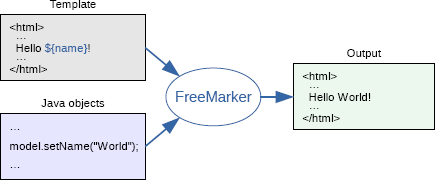
I think HTML is one application area of FreeMarker. Consider 3rd party systems providing APIs consuming XML data or their own data structures. Construct their data format in the code is a grubby approach and furthermore the code becomes not maintainable. Using such a library you can manage your data exchange template outside your code and produce the final data by using the template engine. I see such template engines as classical transformers as in an Enterprise Service Bus:

In the above exmple you see, that you can use placeholders in your template files, which will be replaced by the real data when the transformation takes place. FreeMarker provides enhanced constructs such as if statements, loops and other stuff which can be used in your template files.

Template engines are often used in Web Frameworks, but the usage of template engines is also very useful when you must produce specific output for other systems.

Monday, November 09, 2009

[Tech] Integrate Tests as a Language Featuere?

The blog of Cedric Beust (author of TestNG and captured by Google) is always an interesting read.

His last posting discusses the question if generic test features should be included into the language:

http://beust.com/weblog/archives/000522.html

He mentioned an interesting D feature. Personally I think a tighter language integration is useful for small projects. Nevertheless it should be easy to switch to the best testing tools (as TestNG) in bigger projects.

What do you think?

Sunday, November 08, 2009

[Misc] Subversion turns into an Apache Project: so what?

Since a few days it is official: The Subversion project has submitted to become an Apache project. It seems that the incubation phase will start soon. Now my question: Subversion is conceptually dead, so what difference does that make? Ok, let's discuss this a little more in detail:

The thing is: most developers (even myself) meanwhile understand the concept of DSCM systems and all available projects are stable, fast, have good communities and are reasonably documented. Even tool support (IDEs, ...) is decent. Having understood DSCM I wonder why I would want to go back to a centralised system like SVN. There is no benefit in there for me. If I want to work server based so be it: I can do this with Mercurial for example in BitBucket, with Git in GitHub or by simply installing the DSCM on an arbitrary server that has ssh access.

I had a discussion with an Apache commiter recently about this fact and about the future of Subversion. He believed, that Subversion could (or better should) go through a complete redesign to embrace features provided by distributed source code management (DSCM) systems like Bazaar, Mercurial or GIT. I personally question this future of Subversion. We already have three pretty good systems and a very competitive game is played here since the last two to three years. Subversion would start with a delay of probably three years. Until a stable version of a (partly) distributed SVN is out, all other systems will be settled and far ahead.

There is, however, one major feature DSCM-systems can not provide by definition: this is collaboration via locking. This is an important feature for collaboration on (large) binary files like Photoshop documents, multimedia files, vector graphics and the like. Merging of such documents is practically not possible, but many (software) projects partly rely on a significant number of documents of that sort. Keeping those in a DSCM system is not the best idea. My future scenario for distributed (software) development hence consists of two repository types: a distributed one for sharing text-based files (like sourcecode) and a centralised one that provides versioning and a very good locking (check-in/out) support for (large) binary documents.

Now as I understand it, Subversion is neither really good in locking nor management of binary data either. Also tools-support for non-programmers (who often work with such binary documents) is not so great. So what is the future of Subversion? I believe already today it is pretty much a legacy like CVS. Off course, there are so many projects using Subversion, that we will probably have to deal with it for the next decade (not that I would like to). However, the migration wave has started and most new projects will use one of the mentioned DSCM systems. How could a re-write of Subversion help? Well, the principles are so different that Subversion with distributed characteristics would be either a new project (and I doubt that we need a forth DSCM system, as mentioned above) or would keep a lot of the disadvantages of the old system.

But maybe Subversion could focus on the locking-based approach: this is a very much needed feature for many projects and I also do not see much competition (in the Open Source environment) here. A good repository for binary data could be a reason to stick with Subversion for parts of the development efforts.

Your ideas?

Friday, October 30, 2009

[Tech] 7 Languages in 7 weeks

Dear Readers,

als you are all interested in programming languages I would like to point your interest to this link which I was pointed at (lots of thanks to the source!):

http://rapidred.com/blog/seven_languages

It is from the blog of Bruce Tate we all know as one the Java Experts and his stunning books.

As far as I know he started an interesting project because he was also interested by the polyglot language area. As I heard he raised a vote about the topic and the languages about his next book! The vote together with his opinion lead to the following languages which I would like to comment on:
  • Ruby -> my personal favourite. Perhaps not the coolest now but the expressiveness and the DSLability for me is outstanding.
  • Io -> Possibly the newest and coolest because the vm / object approach looks interesting.
  • Scala -> Good to have Javas crown prince in here because we all have to learn it.
  • Erlang -> My multiprocessor king (even if it struggles with strings. argh). Especially hot in the #nosql database scene.
  • Clojure -> I already posted about the great clojure. I really love it although its really hard to learn.
  • Haskell -> Good that they / he included the right educational functional concept.
  • Prolog -> This surprised me a little. But Bruce writes that he wants to stretch the readers. And I never thought this could go with a nearly 40 year old language.

So have a look on this book at http://pragprog.com. It's is a definite buy for me even if it hasn't been written yet.

Thursday, September 03, 2009

[Process] Distributed Source Code Management and Branching

I am using Mercurial a lot recently (and love it); I really do wonder, why I struggled so long with Subversion. When I first heard the GIT presentation from Linus Torvalds (which is, hm, very entertaining) the whole distributed SCM thing sounded very esotheric for me. However I decided to give it a try, also motivated by the great Chaosradio Express 130 Podcast (German). Yet, I decided to go with Mercurial and not Git; allthough this created some flame-wars within our group, because one of my colleagues is a big Git fan. So be it ;-)

For me Mercurial is a great, easy to install, and pretty easy to understand system. The commandline is really straightforward and the help-texts well written (and interestingly - internationalised). Maybe I follow up another blog post with more details to Mercurial another time.

As easy branching and merging are among the main advantages of the new distributed SCMs, I want to recommend for now the very nice blog-post by Steve Losh "A Guide to Branching in Mercurial". This article provides a good and conclusive introduction to different methods for creating branches with Mercurial and also explains differences to Git and some of it's shortcomings (*g*).

p.s.: For my taste, just one thing is missing: some details on merging.
p.p.s.: Please no comments on my "Git shortcomings" statement, they will be censored out anyway ;-)

Thursday, August 20, 2009

[Arch] UML Tools for Mac OS X

Following up a question I received via Twitter, and the fact, that a significant part of the developer-community is using Macs, I thought this might be a good opportunity to discuss some "UML Options" for the Mac. Now, this article is not meant as a definitive answer, I would hope for some follow-ups by readers in the comments.

Ok lets start: First there is heavy weight stuff, most notable Visual Paradigm. A warning: this is a fat tool. However, among the fat tools it is the one I liked the most. I am not using it any more, but it is generally rather easy to use and very feature rich. However, it is a pretty expensive commercial tool. Yes, they have a "community edition", because it is cool to have a community edition these days. But this one was (when I used it last year) rather a joke. See it as a test-preview.

There are also other commercial tools as well, e.g. Omondo. I have not much idea about this one though. Anyone?

On the other end of the spectrum are tools like UMLet (or Violet), which are also Java-based and work more or less good also on the Mac. These tools are very basic and one should not expect much. They are definitly not suited for "real" projects or commercial application, but can be a nice option e.g. for educational purposes. Sometimes one just needs to create some simple UML diagrams for a presentation, paper or book. For such purposes these tools might be useful. Plus both are Open Source tools.

The probably best free (but not Open Source) UML tool, and the one I would recommend is BOUML and this is sure worth a try. The main issue I have with nearly all free/OS UML tools is, that they are often driven by a single person or just very few developers. Hence the future of the particular tool is always a little unclear. To make things worse, there is no accepted open file-format for UML diagrams, that would allow easy exchangeability of the tool. Hence selecting a UML tool is always sort of a lock-in situation.

Also a consideration could be ArgoUML, which is also an Open Source tool and maybe the oldest one around. Has some issues as all OS tools, but apparently has a functioning community.

Finally there are some more or less general purpose drawing programs, that can be used for technical diagrams like EER or UML models as well (with some limitations) like OmniGraffle or Concept Draw and finally also OpenOffice Draw can be used for general purpose vector-oriented diagrams.

Would be happy about comments, experiences and further suggestions!

Thursday, July 02, 2009

[Tech] Monitor your WS calls

If you develop applications, which consumes web services from other applications or integration platforms, debugging can often be very deflating. If you don't use the correct debugging tools, you don't see the generated SOAP messages which are delivered between the parties.

A very useful tool is the Open Source SOAP monitoring tool from predic8. The tool does the same as the TCP monitor from Axis, but provides a more user friendly UI and more settings and features:
  • Monitoring of SOAP and HTTP messages
  • Rule based SOAP routing
  • XML formatting and syntax highlighting for SOAP messages
  • Interception and modification of messages
  • HTTP chunking
  • HTTP 1.1
  • Loading and saving of configurations
  • Rich graphical User Interface
  • Resending of messages
The monitor acts as a proxy. Therefore your client application must send the SOAP/HTTP messages to the proxy monitor, which delegates the messages to the real endpoint. A Quick Starter Guide is also available.

Tuesday, June 09, 2009

[Tech] Cloud Computing

As I think, I already mentioned here, I believe, that Cloud Computing (and Software as a Service, but this is a slightly different topic) are true game changers in our understanding of software infrastructure and development/deployment. Currently things are still quite rough around the edges, but I believe, that in like 3-5 years the default option of application deployment will be in one cloud service or another. Putting iron into the cellar or storage-room will be what it should be in my opinion: mostly a stupid idea ;-)

In the current stream of IT Conversations George Reese talks about practical aspects and experiences with current cloud-services like Amazon S3, Simple DB, virtualisation... Recommended!

Tuesday, May 26, 2009

[Tech] Kent Beck's JUnit Max

JUnit is a testing-framework well known to every Java developer (according ports to other languages exist). Kent Beck and Erich Gamma were the core-developers of JUnit, which was published around 2000 as Open-Source framework. It is fair to say, that JUnit and its ports had a huge influence on quality assurance and can be found in nearly every modern software project.

Now Kent Beck announced a new project JUnit Max. The core concept is "continuous testing". JUnit Max is an Eclipse plugin that starts the unit test execution everytime a class is saved and controls the test-execution ordering according to the classes that are worked on and tests that have failed recently.

In my opinion this seems to be an interesting and logical next step in unit-testing-frameworks. JUnit Max however is not Open Source and follows (in my opinion) a rather strange license model (more can be found on the website). I wonder, whether the additional benefit justifies the license fees and this particular model and more important, how long it will take until this functionality is provided by an Open Source solution...

Tuesday, April 21, 2009

[Tech] What about Maven 3

At thte last Maven Meetup Jason van Zyl talked about the future of Maven and important milestones of Maven 3, including:
  • Support of incremental buildings
  • Changes about the Plugin-API
  • Better Multilanguage support
  • and more
The video and slides about the presentation are available here.

Saturday, April 11, 2009

[Misc] Open Protocol vs. Twitter: 1:0 ?

In a current ZDNet Blog Posting, Sam Diaz analyses the recent technical issues Twitter has (again). Twitter is growing dramatically in the last months and apparently the Twitter backbone is increasingly in trouble. The same happened already about a year ago.

The analysis of Sam Diaz is of course correct, but in my opinion he still completely misses the point in discussing technical issues why Twitter might or might not catch up with the upcoming demand in the service. The point actually is, that the communication concept of Twitter is appealing to many people, which is good, but in the history of the Internet it was never a good idea to rely on a proprietary protocol in any important communication channel.

So the real question is a much more generic and actually should be: how can we get rid of Twitter as fast as possible and replace it with an open protocol and a scalable distributed architecture, comparable to Email, XMPP chat and the like. There are good reasons why proptietary protocols largly failed on global communication systems like the Internet; those that are still around are a continuous pain in the ...

I confess, I am using Twitter as well, but it is of course a lock-in situation. If you want to follow the interesting stuff, you currently have to use Twitter. However, now we still have time to replace Twitter with something like Laconica (identi.ca) or anything similar down the road. Even better, Twitter might open up it's system and try scaling it that way. However, now is the time to act: Twitter is still a toy, but it is on the way to become a serious communication system we might depend upon in some years. And I believe, no one wants to depend on a communication system that is proprietary and unreliable at the same time.

Thursday, April 09, 2009

[Tech] Mavenizing AppEngine!

As I nagged yesterday about the fact, that AppEngine has no proper Maven-build system, already today the guys at Sonatype reacted ;-)

They describe preliminary attempts in how to "Mavenize" AppEngine projects; hope they will be able to fix also the last issues!

Wednesday, April 08, 2009

[Tech] Google AppEngine (and Java)

AppEngine is a rather recent new service from Google. It is probably Google's answer to Amazon's cloud-computing platform, yet targets a very different market. Where Amazon offers a a broad range of services and high flexibility (with the disadvantage of higher administration effort) Google targets web-developers that want to publish web-applications. AppEngine started with a Python environment, now since some days the long anticipated Java-version (Java 5 and 6) is online. Now what are the benefits of using AppEngine?

Java

First of all, it is possible to deploy applications without having to install, administrate and maintain an own server (instance). Google provides a runtime environment (sandbox) into which Python or Java applications can be deployed. Access to these applications is (for clients) only possible via http(s). So this is a feasible approach for web-applications or RESTful services.

An additional advantage is, that Google deals with scaling issues, i.e. it scales the applications dynamically to the demand. This is a significant advantage for startups, that have no clear idea about the number of customers they are going to have or how fast this number is growing. For the scaling to work, though, some restrictions have to be considered. Most notably this concerns the persistence strategy. E.g. applications (and libraries!) are allowed to read files from the filesystem, but are not allowed to write. For all persistence issues, the Google datastore has to be used. However, what is nice with the new Java-sandbox is the fact, that Google apparently tries to follow established standards. For persistence Java developers can use JDO or JPA or a low-level interface for the distributed datastore.

I wonder, however, how logging can be handled in that environment. Logging is usually done to a file or to a JDBC datasource. A JDO logging target I have not seen before; ideas anyone?

Generally spoken, arbitrary Java libraries can be deployed and used in the AppEngine as long as they do not violate the AppEngine sandbox. Also due to the scaling-approach not all libs/frameworks will run unchanged. As yet, it seems not quite clear for example, which Java Web-Frameworks will run seamlessly in the App-Engine. Googles webtoolkit (GWT) should work, other framework communities are currently testing their frameworks for compatibility, e.g. in the Apache Tapestry and the JSF framework Apache myFaces discussions are running on the mailinglists.

Build Automation and Development Process

The development process is, in my point of view, as also with other Google environments like GWT a mixed blessing. Everything is Eclipse centered, which is not really a good thing: Google provides an Eclipse plugin for the AppEngine including a runtime environment for testing applications offline. This is great for daily development activity, but not for a stable build- and testing environment. Unfortunately Maven support (like archetypes) are completly missing at the moment. Google is apparently pretty hostile towards Maven and focuses mostly on IDE integration, which is definitly not a sound way for a modern build automation. IDE "wizard-based" SE approaches usually turn out to be unstable and problematic, particularly in team-projects. This might be nice for a fast hack, but is no basis for a larger project. It seems, that some support is given for Apache Ant though.

Hopefully other developers will provide a Maven integration for the Java AppEngine. With the current approach not even an IDE-less deployment is possible.

Conclusion

So, despite of the build-issues, I believe that the AppEngine is a great option to deploy web-applications in Java or Python. For small applications (small in the sense of "low web-traffic"), the AppEngine is free, after exceeding certain thresholds (CPU, storage, bandwith...) one pays according to the resources needed. Google provides a web-interface to set daily financial limits for individual resources. E.g. one wants to spend a maximum of 5 $ a day for CPU time and so on.

Looking forward to the first experience reports, particularly with web-frameworks like Wicket, Tapestry or Cocoon.

Wednesday, April 01, 2009

[Misc] Operating Systems for Netbooks

Netbooks are different from notebooks and desktops; they are used in other contexts, have smaller screens, not so powerful hardware, less diskspace and so on. Windows is hardly the best system for regular desktops and notebooks (in my opinion) and definitly only a temporary solution for the netbook market. Microsoft even had to reanimate Windows XP for that purpose. In effect, Windows is to fat, too insecure and not optimised for small screens and additionally hardware producers have to pay license fees to Microsoft in a very tight market, where some Euro can make a difference.

Since some months the companies like HP apparently are evaluating Google's Android for Netbooks. Now, I am all for Android; But on mobile phones. I am doubtful that Android is a good solution for netbooks though. Android was designed for the typical smaller scale mobile applications e.g. with only "one application" active on the screen. And resource management that focuses on one active application. Now, a Netbook might have a small screen as well, but from the usability point of view it is probably closer to the notebook than to the mobile phone.

Hence customers expect applications in a style they know them from their desktop, like Office or Internet applications (mail, browser, ...). Using Android reduces the number of suitable applications dramatically, and Android applications written for Android cell-phones will most likely not perform well on Netbook hardware.

Now, Linux was already used on several Netbooks like on the EEE-Series. Why not stick to Linux? Probably adapt an existing distribution like Ubuntu to better fit to that specific environment. Then immediately the whole range of destop applications are available including applications like Open Office.

From the software engineering aspect, I would believe, that it is better not to mix up mobile platforms with Netbooks, in the end either applications have a bad user experience on the specific platform they were not developed for (allthough both use the same OS).

But maybe I am proven wrong?

Wednesday, March 25, 2009

[Tech] HSQLDB Version 1.9 alpha is out

Finally hsqldb 1.9 (alpha, though) is released. This release was announced for, I believe, nearly one year. It seemed to me already that hsqldb is a rather dead projects. I am glad they made the next round, because in a way I still like that system a lot. Sure, Apache Derby is most likely the superior system, and H2 looks very promising too (but is still, as I understand it, a "one man show" without community) however hsqldb has some tiny details that make it very nice: First, it always had a really tiny footprint and was extremly easy to understand and use.

And I particularly liked the feature to fine-tune the memory management, i.e., should the data be stored on disk, purely on memory... and this on a per-table basis. Plus, with one simple command it is possible to write the whole database as SQL statements into a file from which it is also loaded again from that file. A feature that is e.g. missing in Derby. This often turned out handy during development-phase.

Now for version 1.9 they seem to have rewritten significant parts of the software and added an impressive list of new features. What I have to figure out is, if they have finally implemented proper transaction isolation. In my opinion this was (beside the single-threaded kernel) the biggest issue in the previous versions, where dirty read could not be avoided. I am a little bit confused with the announcement(s) now, because they wrote that they have rewritten the core, however, in a forum posting the developers announced, that transaction isolation is not handled in the new release 1.9 but is planned for 2.0. The news announcements on the sourceforge are a little bit confusing for me. Does anyone have a better idea about this issue?

However, good luck for the stabilisation-phase of the new release!

Friday, January 23, 2009

[Tech] An easy to use XML Serializer

XML processing is an important part in present software systems, especially when communicate with other software components in the IT infrastructure. Pretty often you must provide your object data as XML. The Open Source market provides a wide range of XML tools, above all XML mapping tools, like Castor, JAXB and others. A very intersting and compact tool, existing since 2004 is XStream hosted on Codehaus. XStream is a proved XML serializing library and provides the following key features:
  • Easy to use API (see example)
  • You do not need explicit mapping files, like other serializing tools
  • Good performance
  • Full object graph support
  • You can modify the XML output
Let us consider a simple business object, person, implemented as a POJO (taken from the XStream homepage):

public class Person {
private String firstname;
private String lastname;
private PhoneNumber phone;
private PhoneNumber fax;
// ... constructors and methods
}

public class PhoneNumber {
private int code;
private String number;
// ... constructors and methods
}
In order to get a XML representation of the Person object we simple use the XStream API. We also set alias names which are used in the output XML.
XStream xstream = new XStream();
xstream.alias("person", Person.class);
xstream.alias("phonenumber", PhoneNumber.class);
String resultXml = xstream.toXml(myPerson)
When creating a new instance of the person object an serialize it via xstream (toXml) we get the following XML result. As we can see our alias names are used.

<person>
<firstname>Joe</firstname>
<lastname>Walnes</lastname>
<phone>
<code>123</code>
<number>1234-456</number>
</phone>
<fax>
<code>123</code>
<number>9999-999</number>
</fax>
</person>

The example illustrates that the framework is very compact and easy to use. Look at the 2 Minute tutorial on the XStream homepage to get more examples. You can also implement custom converter and transformation strategies to adapt XStream to your requirements.

Have fun with XStream.